
Easy crochet patterns, cute projects, and beginner-friendly ideas to inspire your next make.


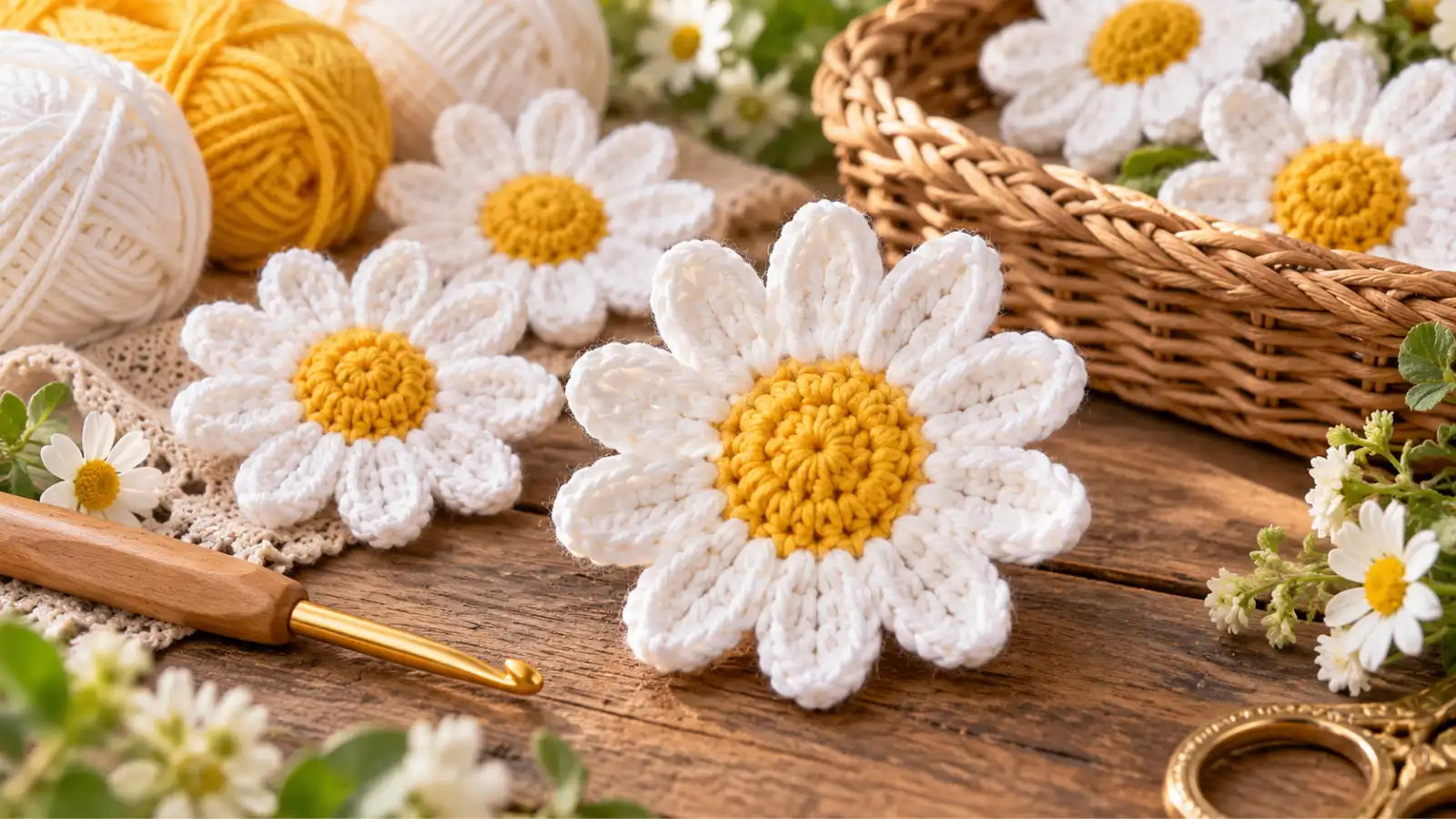
This crochet daisy pattern makes a classic flower with a contrasting center and 10 simple petals. It is worked in just two rounds, so once the center is finished, each petal follows the same repeat around the flower.
This version begins with a magic ring and uses basic crochet stitches plus treble crochet for the petals. If treble crochet is new to you, I’ve included the steps below before you start the pattern.
The finished size and completion time have not been independently measured, so I have not added estimates for them. If you’d like to try another simple flower next, see our easy crochet flower pattern for a five-petal version with a different construction.
Table of Contents
Crochet Daisy Pattern at a Glance
| Pattern detail | Information |
|---|---|
| Skill level | Beginner-friendly with basic crochet knowledge |
| Crochet terms | US terminology |
| Construction | Worked in 2 rounds |
| Foundation | Magic ring |
| Petals | 10 |
| Hook | 3.75 mm |
| Yarn | Medium #4 acrylic yarn |
| Main stitches | ch, sl st, dc, tr |
| Gauge | Not specified |
| Finished size | Not independently measured |
| Making time | Not independently verified |
The pattern uses one stitch from the center for each petal. That makes the stitch count especially useful: 10 center stitches become 10 petals.
What You’ll Need
For one crochet daisy, you will need:
- 3.75 mm crochet hook
- Medium #4 acrylic yarn
- Yarn for the flower center
- Yarn for the petals
- Scissors
- Yarn needle for weaving in the ends
For a traditional daisy look, use yellow for the center and white for the petals. You can also change the colors without changing the construction of the pattern.
Crochet Stitches and Abbreviations
This pattern uses US crochet terminology.
- ch — chain
- sl st — slip stitch
- dc — double crochet
- tr — treble crochet
- st — stitch
- yo — yarn over
If you are still getting comfortable with crochet abbreviations, it helps to check each stitch before starting rather than trying to remember everything while working the petals.
How to Make a Treble Crochet
Treble crochet is taller than a double crochet and gives the daisy petals their length.
To make one US treble crochet:
- Yarn over twice.
- Insert your hook into the indicated stitch.
- Yarn over and pull up a loop. You should have four loops on your hook.
- Yarn over and pull through two loops.
- Yarn over and pull through two loops again.
- Yarn over and pull through the final two loops.
One treble crochet is complete.
For this pattern, each petal uses one treble crochet between two chain-4 sections.
Before You Start
A few details are worth checking before you begin:
- The daisy is worked in two rounds.
- Round 1 forms the center.
- Round 2 forms all 10 petals.
- The pattern begins with a magic ring.
- The beginning
ch 2in Round 1 counts as part of the center stitch count. - You should have 10 center stitches before starting the petals.
- Each center stitch is used for one petal.
- Round 2 is worked in a contrasting petal color.
- Count the petals as you work instead of waiting until the end.
The center count is the easiest way to avoid problems later. If Round 1 does not contain 10 stitches, the petal round will not divide evenly.
New to crochet flowers? Start with our easy crochet flower pattern for a smaller five-petal project with a simple construction.
How to Crochet a Daisy Step by Step
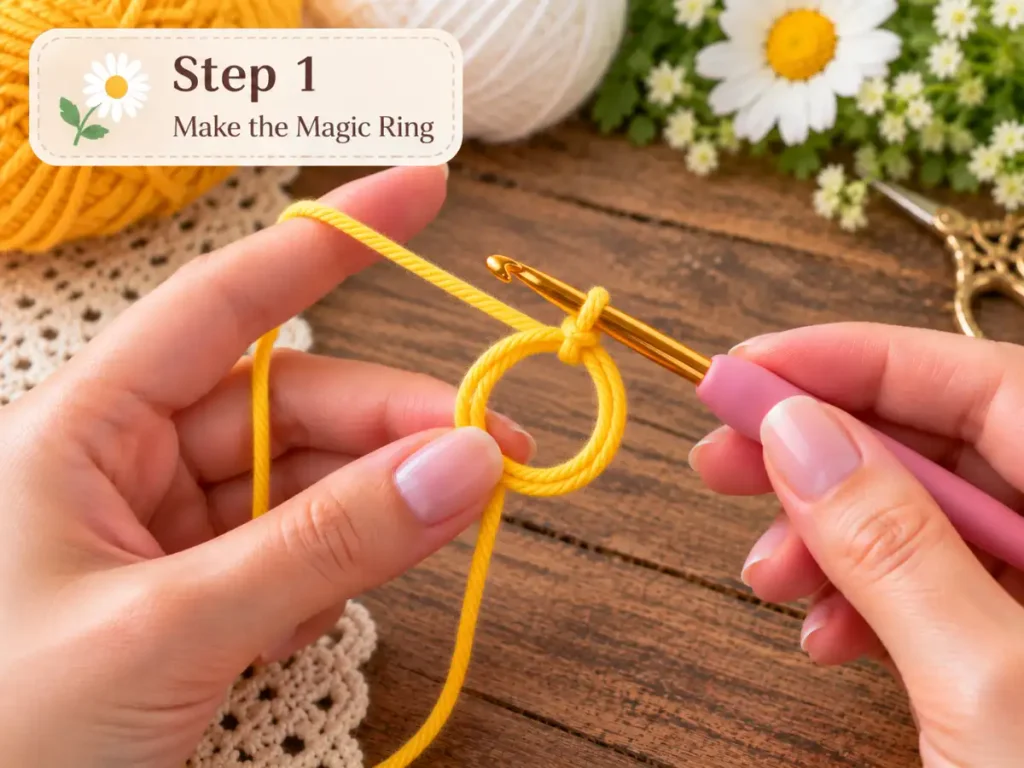
Step 1: Make the Magic Ring
With your center color, make a magic ring.
Keep the ring open enough to work the center stitches comfortably. You can tighten it after the stitches for Round 1 are in place.
If magic rings are still new to you, focus on keeping the adjustable yarn tail separate from the working yarn so you can identify which strand to pull when closing the center.
Checkpoint: You should have one adjustable loop ready for Round 1.
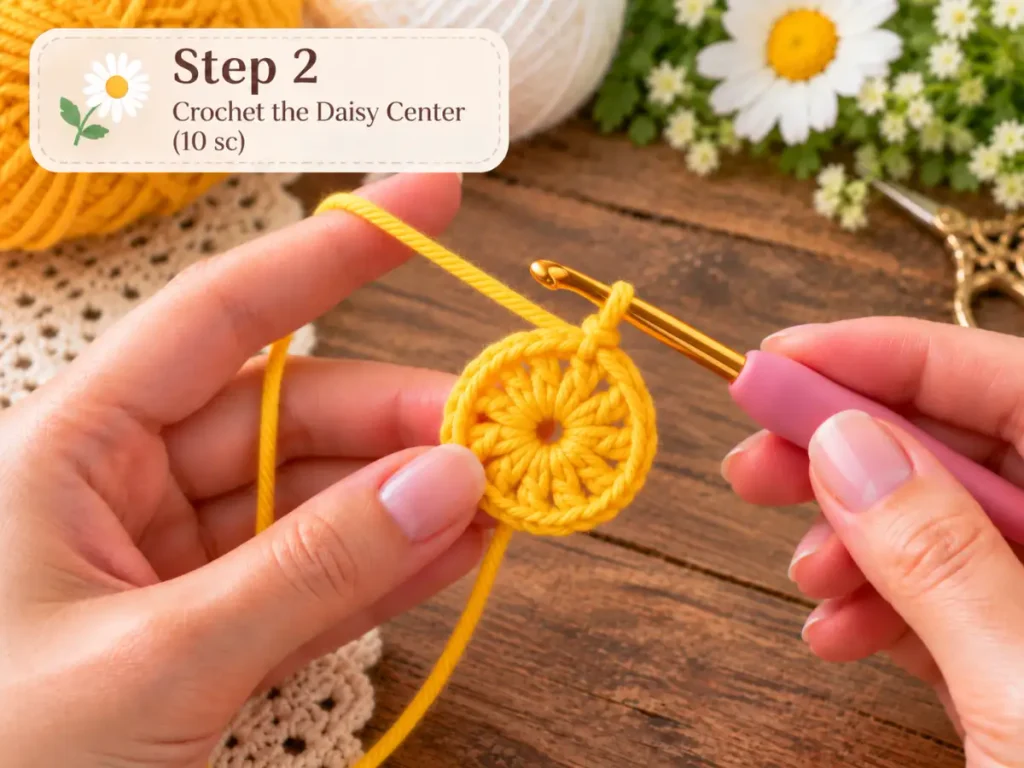
Step 2: Crochet the Daisy Center
With the magic ring ready:
Ch 2.
The beginning chain counts toward the center stitch count.
Work:
9 dc into the magic ring.
You should now have the equivalent of 10 center stitches when the beginning chain is included.
Join the round with a slip stitch as shown in the pattern, then gently pull the magic-ring tail to close the center.
Fasten off the center color.
Center checkpoint
Before adding the petals, stop and count.
You should have:
10 stitches around the center.
Do not continue if you have nine or eleven. Each of these 10 stitch positions will support one daisy petal.
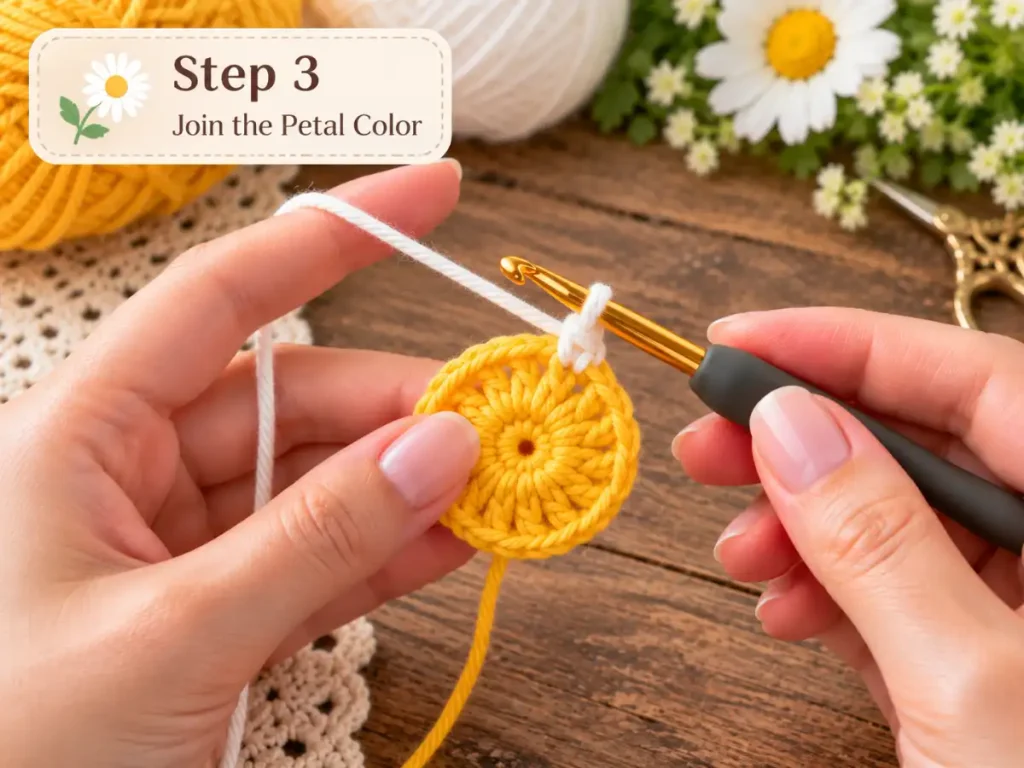
Step 3: Join the Petal Color
Make a slip knot with your petal color.
Insert your hook into any stitch from Round 1 and join the new yarn with a slip stitch.
Keep the join secure without pulling it excessively tight. A very tight join can make the first petal sit differently from the others.
You are now ready to work the first petal.
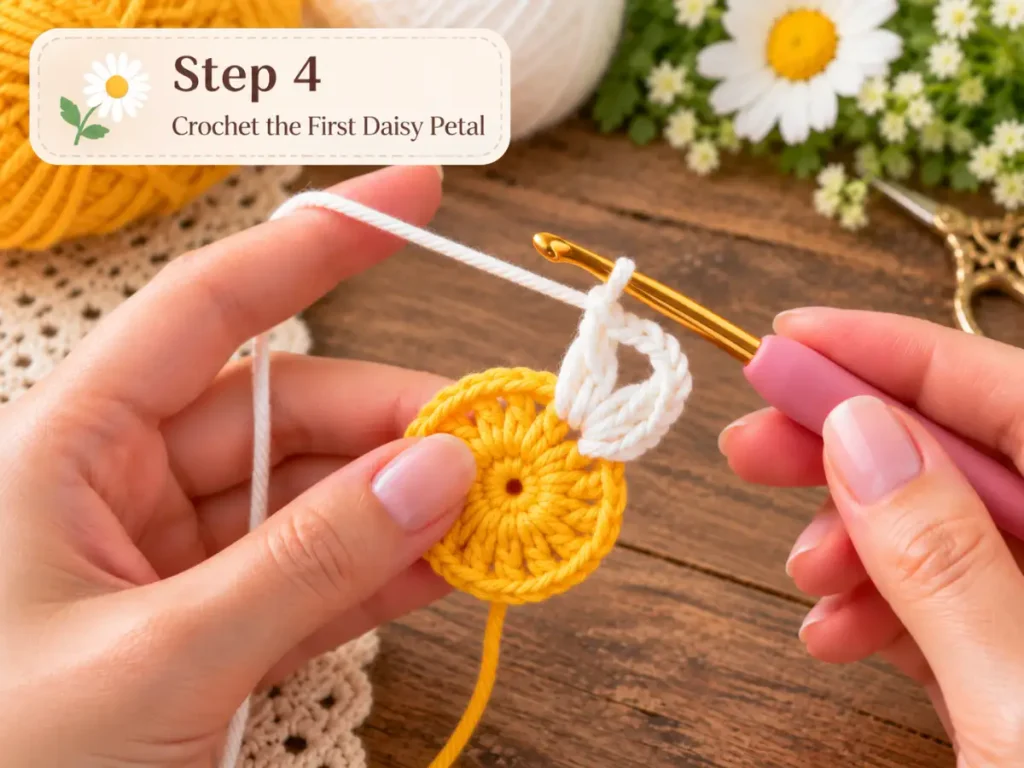
Step 4: Crochet the First Daisy Petal
In the same stitch where the petal color is attached, work:
Ch 4.
Then make:
1 tr in the same stitch.
Next:
Ch 4.
Finish the petal with:
Sl st in the same stitch.
Your first petal is complete.
The petal sequence is:
ch 4 → 1 tr → ch 4 → sl st
All parts of the petal are worked from the same center stitch.
First-petal checkpoint
Before repeating the pattern, check that:
- both chain-4 sections come from the same center stitch;
- the treble crochet is also worked into that stitch;
- the petal finishes with a slip stitch in the same stitch;
- the petal sits above one center stitch rather than spreading across several stitches.
This placement is important because each of the 10 center stitches needs to produce one petal.
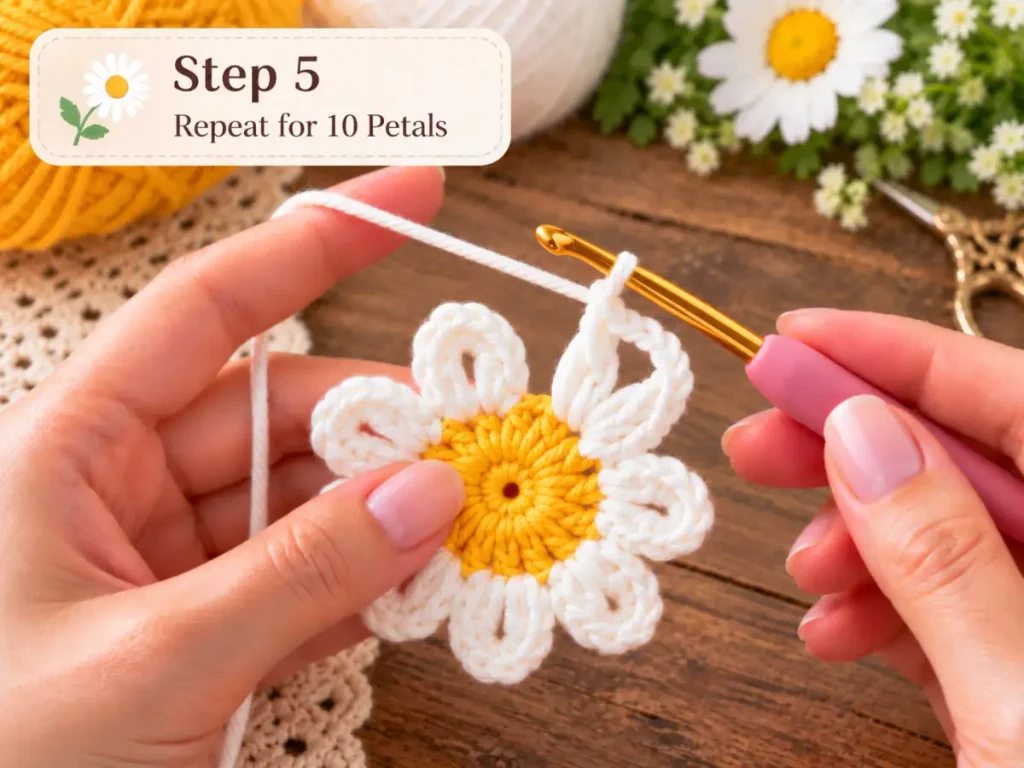
Step 5: Repeat for 10 Daisy Petals
Move to the next stitch in the center.
Work the same petal sequence:
Sl st in the next st, ch 4, 1 tr in the same st, ch 4, sl st in the same st.
Continue around the flower, making one petal in each center stitch.
Repeat until all 10 stitch positions have been used.
Petal checkpoint
You should now have:
10 petals
The petals should form an even ring around the center.
If you reach the starting point with only nine petals, check whether one center stitch was skipped. If you somehow have more than 10, check whether two petals were worked into the same stitch.
Do not add or remove a petal simply to make the flower look even. Correcting the stitch placement will give you a cleaner result.
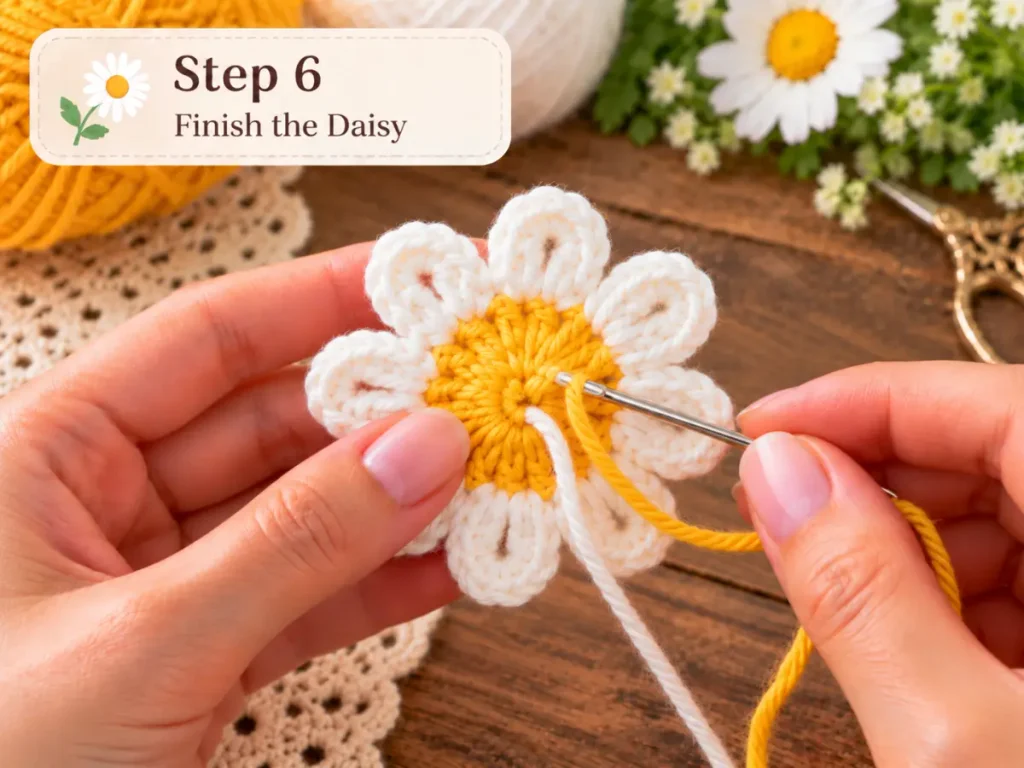
Step 6: Finish the Daisy
After completing the final petal, join neatly at the beginning of the petal round with a slip stitch.
Then:
- Fasten off the petal yarn.
- Pull the final yarn tail through securely.
- Turn the flower over.
- Weave the center-color tail through nearby stitches on the back.
- Weave in the petal-color tail without pulling the edge out of shape.
- Trim the yarn only after the ends are secure.
Gently arrange the petals with your fingers.
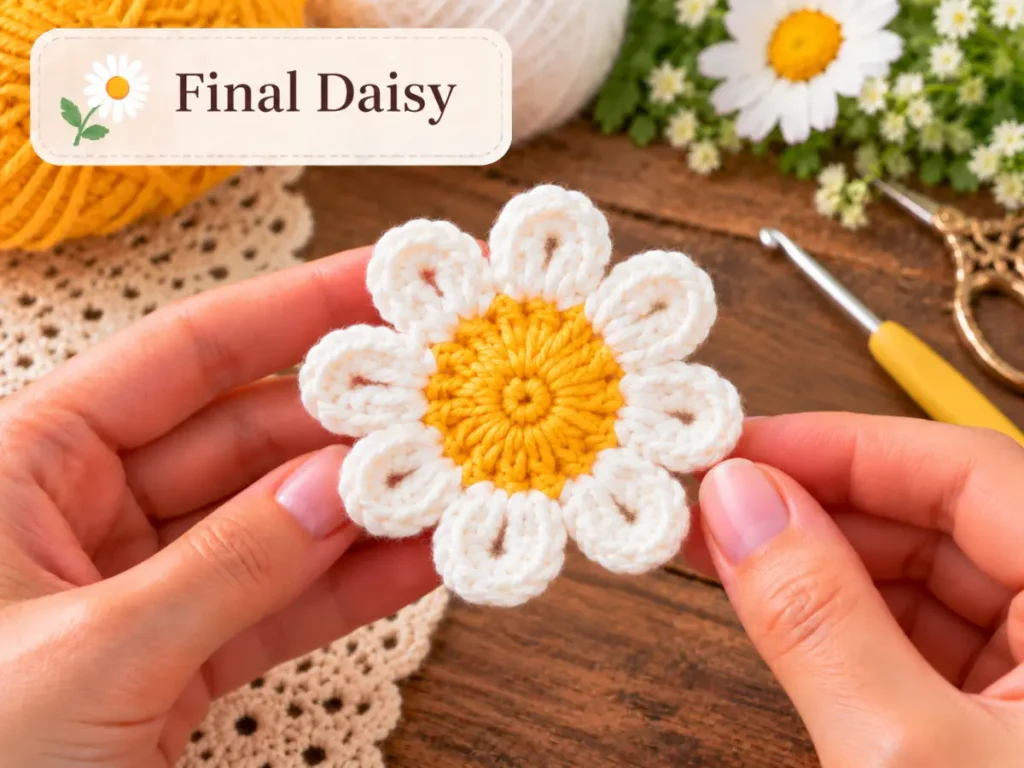
Final checkpoint: Your daisy should have one center surrounded by 10 evenly spaced petals.
Common Problems and How to Fix Them
Why do I have fewer than 10 petals?
Count the center stitches from Round 1.
The pattern needs 10 center stitch positions, with one petal worked into each stitch. A skipped stitch in either round will reduce the final petal count.
Why do I have more than 10 petals?
You may have worked two petals into the same center stitch.
Follow the top of the center round carefully and make sure you move to the next stitch before beginning each new petal.
Why are some petals longer than others?
Treble crochet is a tall stitch, so changes in tension are easy to see.
Try to keep the loops at a similar height when working each treble and avoid tightening one chain section much more than another.
Also check that every petal contains exactly:
ch 4 + 1 tr + ch 4
Why does one petal look different near the yarn join?
The first and last petals meet at the color-change area, so a bulky join or loose yarn tail can make that section look different.
Keep the initial slip stitch neat, then weave the tail into the back of the center after the flower is finished rather than pulling it tightly across the front.
Why is my magic ring still open?
After completing the center stitches, gently pull the adjustable tail of the magic ring.
If it does not close, check that the stitches were worked around both strands of the ring correctly and that the adjustable strand has not been trapped.
Avoid forcing the yarn if it stops moving.
Why are my petals curling?
A small amount of movement is normal in a crochet motif.
First check your stitch counts and petal construction. If all 10 petals are correct, gently shape the flower with your fingers after weaving in the ends.
Different yarns and tension can also affect how flat the petals sit.
Can I Use Different Colors?
Yes.
The traditional combination is a yellow center with white petals, but the stitch pattern does not depend on color.
You could use:
- cream petals with a mustard center;
- pink petals with a yellow center;
- pastel colors for a spring project;
- several different petal colors for a more playful flower.
Changing colors is one of the simplest ways to make several daisies look different without changing the pattern itself.
Can I Use a Different Yarn or Hook?
You can, but the finished flower will change in size and texture.
A thicker yarn and larger hook will generally create a larger daisy. A finer yarn and smaller hook will make a smaller, more delicate flower.
Because this version has not been independently measured across different yarn weights, make one sample daisy first before creating several for a matching project.
Keep the construction the same:
10 center stitches → 10 petals
unless you intentionally redesign the pattern.
Simple Ways to Use Your Crochet Daisy
A flat crochet daisy works well as a decorative motif because there is no stem or bulky construction to work around.
You could use one for:
- a bag or pouch appliqué;
- a crochet keychain or bag charm;
- a headband or hair accessory;
- a flower garland;
- gift wrapping;
- a handmade card or decoration;
- another small crochet project.
If you sew the daisy onto something washable, use secure stitches and consider whether both yarns have similar washing instructions.
For more small flower ideas, browse the Crochet Flowers section of Small Crochet Ideas or explore our other Crochet Patterns.
For a dimensional flower with a stem and leaf, try our crochet tulip pattern. For a bolder design with a dark center and pointed golden petals, make our sunflower crochet pattern.
Frequently Asked Questions
Is this crochet daisy pattern suitable for beginners?
It is beginner-friendly if you already know basic stitches such as chains, slip stitches, and double crochet.
The main new technique for some beginners will be the treble crochet used in the petals. Practice one slowly before repeating the petal around the flower.
How many petals does this crochet daisy have?
The finished daisy has 10 petals.
Round 1 creates 10 stitch positions, and Round 2 places one petal into each of those stitches.
Do I need a magic ring?
This version begins with a magic ring because it allows the center opening to be tightened after the first round.
If you prefer a chain-ring foundation, that would require a modified starting method rather than simply replacing the magic ring without testing.
Can I make the daisy larger or smaller?
Yes, the simplest method is to change the yarn thickness and use an appropriate hook.
That changes the overall scale while preserving the 10-stitch center and 10-petal construction.
Does gauge matter for this pattern?
A specific gauge was not provided.
For a small decorative flower, exact gauge is usually less important than consistent tension unless you need the finished daisy to fit a specific measurement.
Make one sample and compare it with the project where you plan to use it.
Can I crochet the entire daisy in one color?
Yes. The two-color version creates the recognizable contrasting daisy center, but the same construction can be worked in one color.
If you keep the same yarn attached after Round 1, make sure you begin the petal round from the correct stitch position.
A Simple Crochet Daisy, Finished
This crochet daisy pattern uses a simple count that is easy to check as you work: 10 center stitches followed by 10 petals.
The tall treble stitch gives the petals a more recognizable daisy shape than the rounded petals used in our first easy crochet flower pattern, while the two-round construction keeps the project manageable.
Once you are comfortable with the repeat, try making several daisies in the same colors for a coordinated project or use different combinations for small handmade decorations.
Pattern Source & Editorial Note
This written tutorial was created after reviewing the original Pora Pora Crochet daisy flower video tutorial.
The stitch construction was checked against the demonstrated tutorial before the instructions were written. The wording, organization, beginner checkpoints, troubleshooting, and explanations in this article are original to Small Crochet Ideas.
The finished dimensions, gauge, yarn usage, and actual completion time were not independently measured, so they have not been presented as verified project specifications.
